Portrait Lessons from a GFX100S Shoot with My Daughter
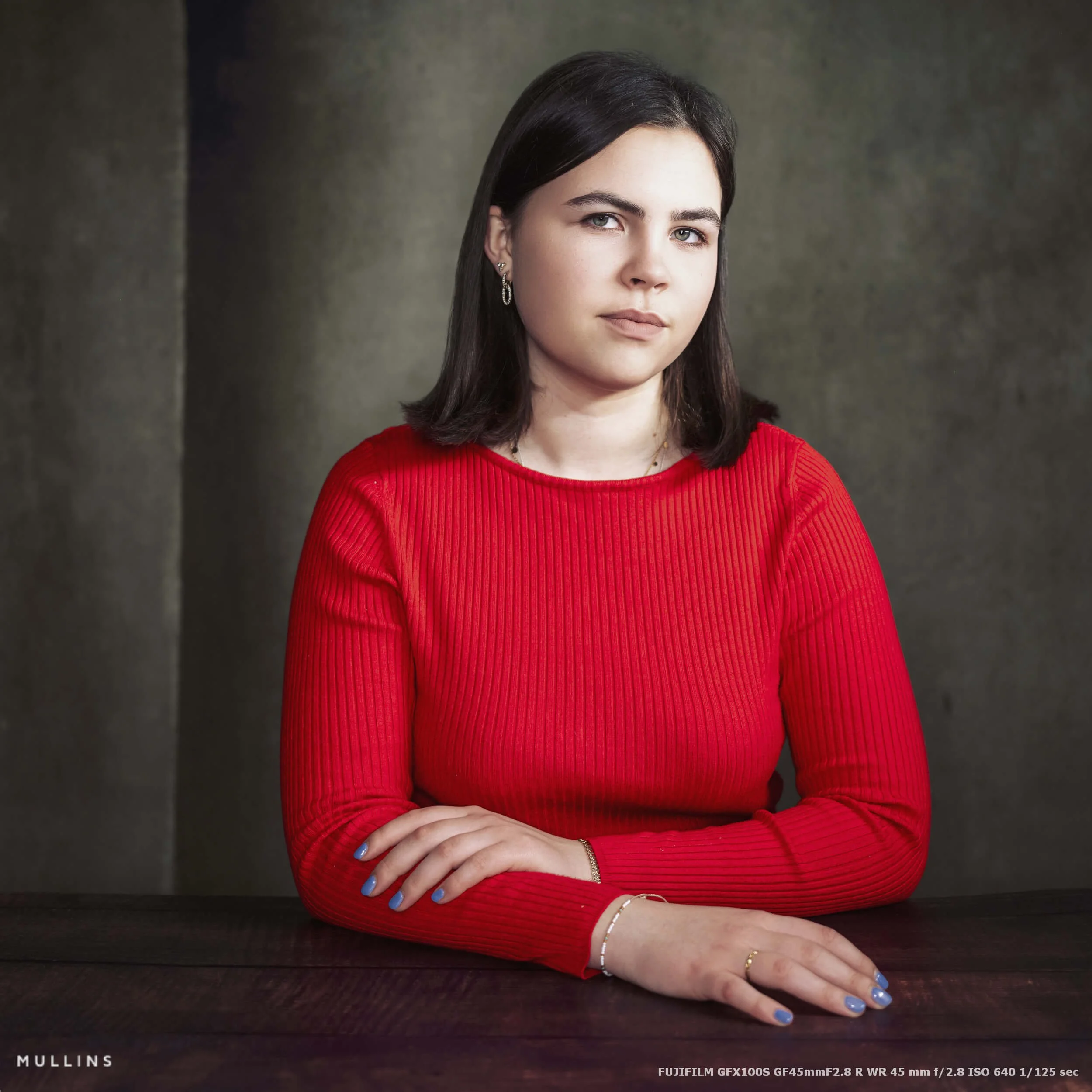
If you’ve followed my work for any length of time, you’ll almost certainly have seen Rosa before.
Over the years, I’ve shared plenty of candid photographs of her growing up, from when she was tiny right through to now. Most of those pictures were made in the way I naturally work anyway - quietly, instinctively, without too much interference from me. I was observing more than directing. Watching rather than shaping.
These portraits were different.
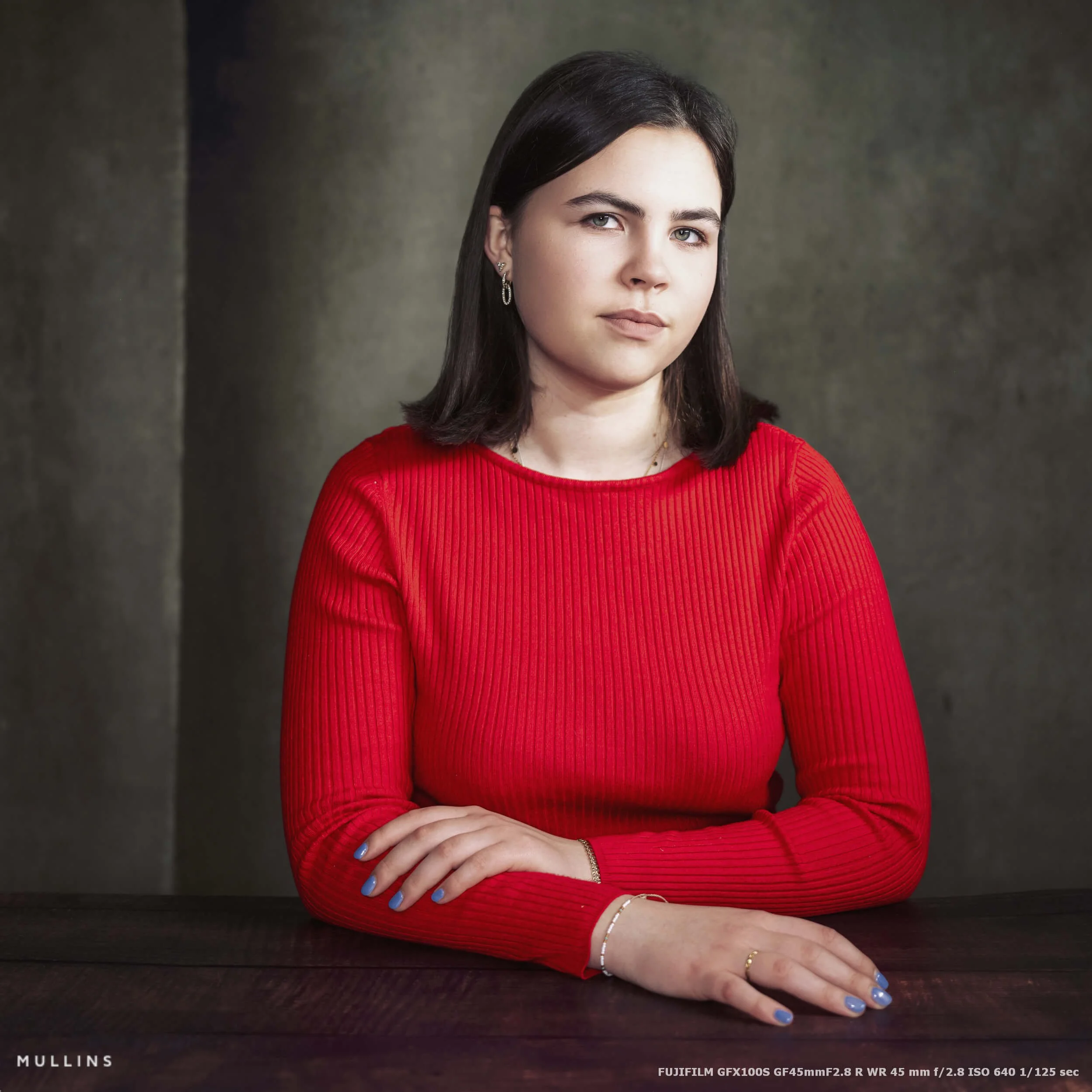
They were made in the studio, with direction and intention. With a little more structure. With a clear idea of what I wanted the final images to feel like. Not stiff, not overworked, not too polished, but definitely more deliberate than the kind of candid family photographs people might already associate with her.
And I think that difference makes this an interesting shoot to discuss, especially for photographers in a similar situation to mine.
Because photographing somebody you know very well can be both easier and harder than photographing a stranger.
When familiarity helps, and when it gets in the way
On the face of it, photographing your own child ought to be easy. There’s trust already there. There’s no awkward small talk to get through. No real barrier. You know how they move, how they hold themselves, what expressions are natural and which ones are forced. All of that helps.
But familiarity can also make you lazy, or perhaps blind is the better word.
When you’ve photographed someone for years, you can stop really seeing them. You carry an old version of them in your mind. You remember them as they were, not necessarily as they are right now. That sounds a bit sentimental, perhaps, but I do think it’s true.
This shoot reminded me of that.
I wasn’t just photographing Rosa as the child I’ve photographed a thousand times in passing. I was photographing her as she is now. Older, more self-possessed, a little more serious in front of the camera, and actually very comfortable with silence.
That changed the pictures. It changed the pacing as well. I didn’t need loads of chatter. I didn’t need to force energy into the room as I do with some portrait clients. I just needed to pay attention.
That, really, was the lesson.
These are not candid pictures, but they still come from the same place
Although these are studio portraits, I don’t think they are disconnected from the rest of my work.
I still want honesty in a frame. I still want the photograph to feel like the person, not like an idea I’ve imposed on them. I’m not especially interested in over-directing people into shapes that don’t suit them. I don’t want ten layers of concept getting in the way of expression. I want simplicity, good light, decent composition, and a sense that the person in front of the lens has been allowed to remain themselves.
That’s probably the documentary photographer side of me creeping in.
So even in a more controlled portrait session like this one, I’m still looking for restraint.
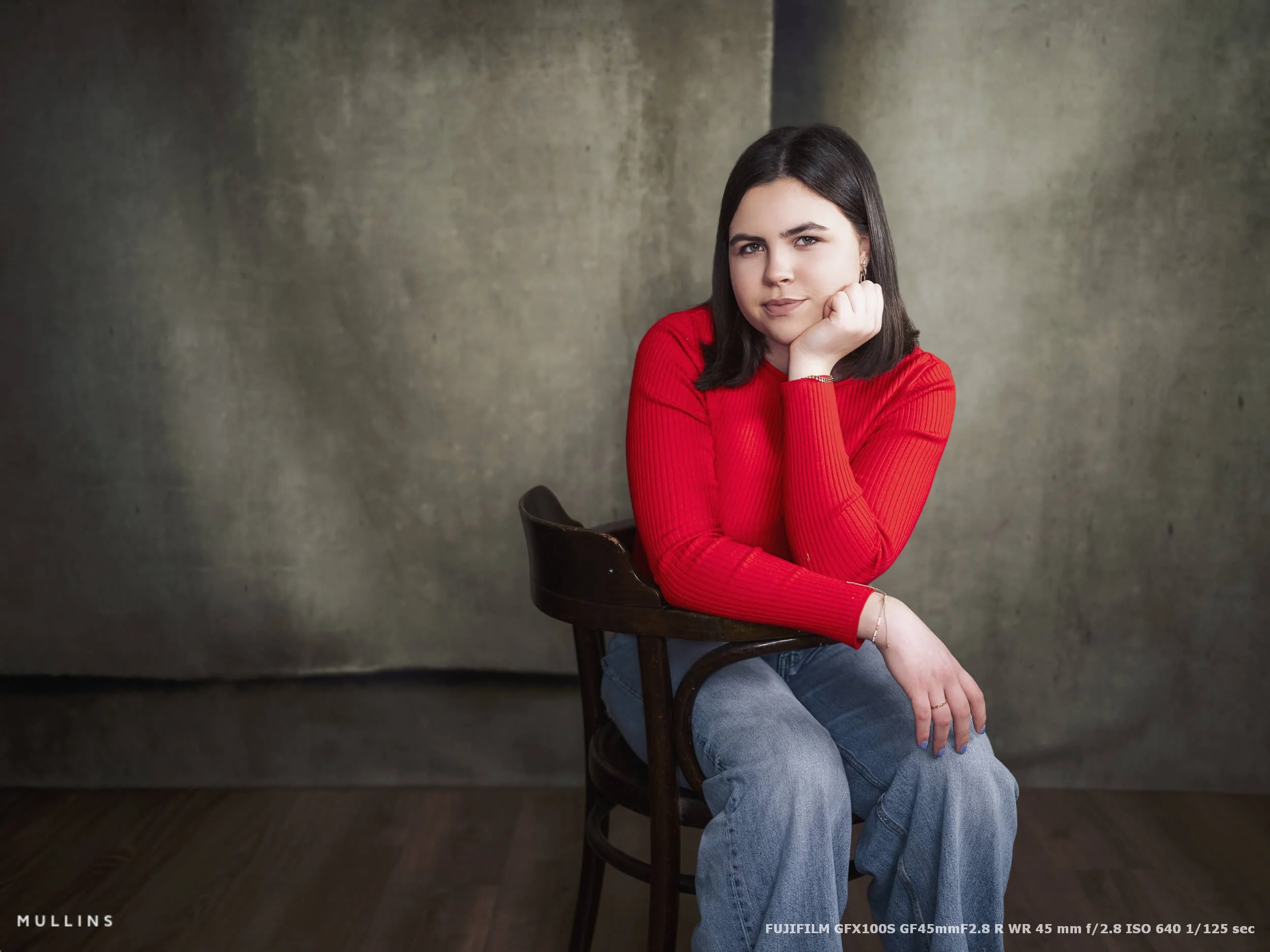
A small shift in posture. A glance that feels unforced. Hands that settle naturally. Tiny things, really. But tiny things are often what make a portrait believable.
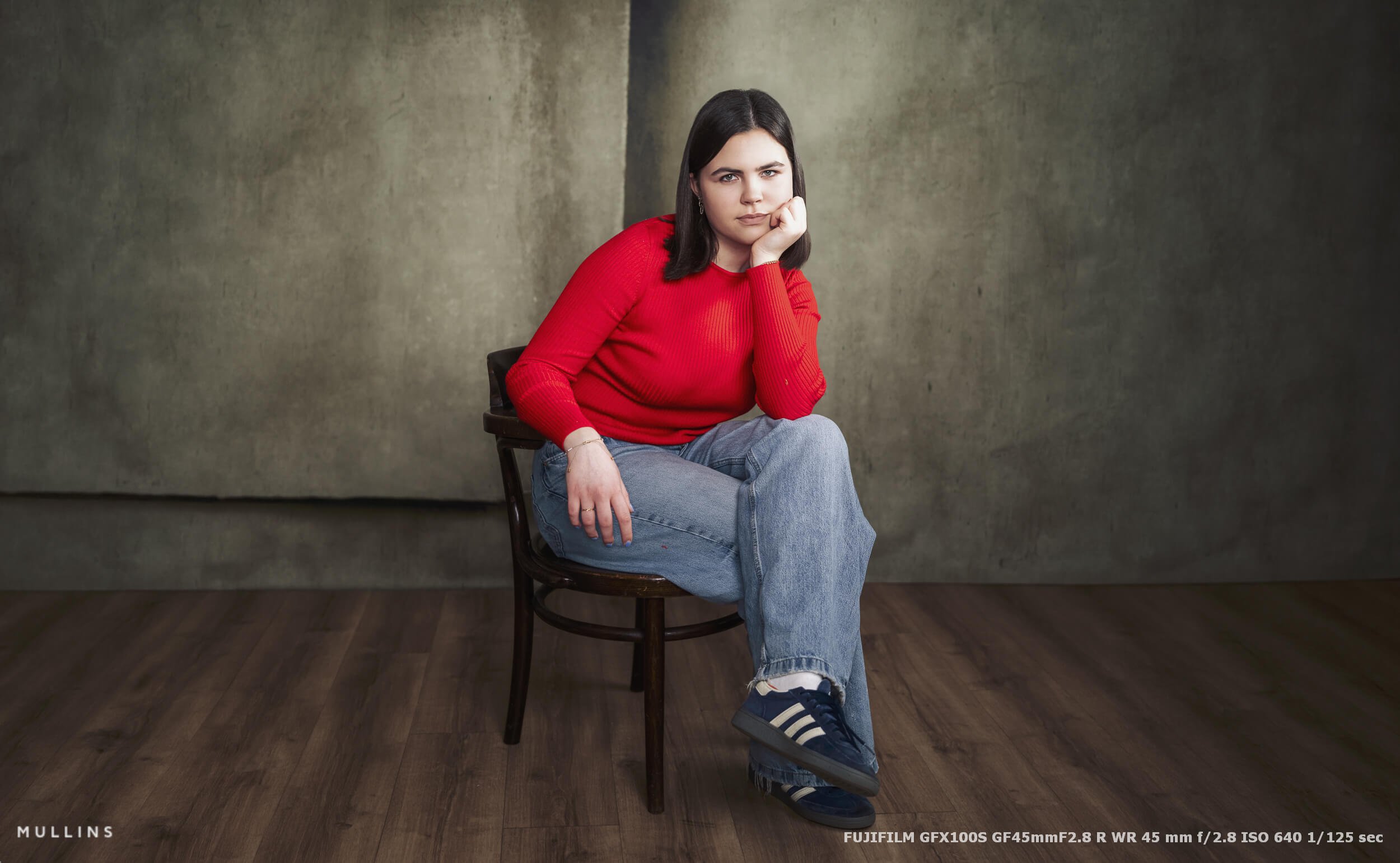
Why I used both the GF45mm and the GF80mm
This shoot was made on the Fujifilm GFX100S using a combination of the GF45mm and GF80mm, and each lens gave me something quite different.
The GF45mm is one of those lenses that I think can be underrated for portrait work if people are only thinking in traditional terms. A lot of photographers instinctively reach for longer glass for portraits, and I understand why. Compression is flattering, backgrounds simplify more easily, and it can all feel a bit safer.
But the 45mm gives you room to say more.
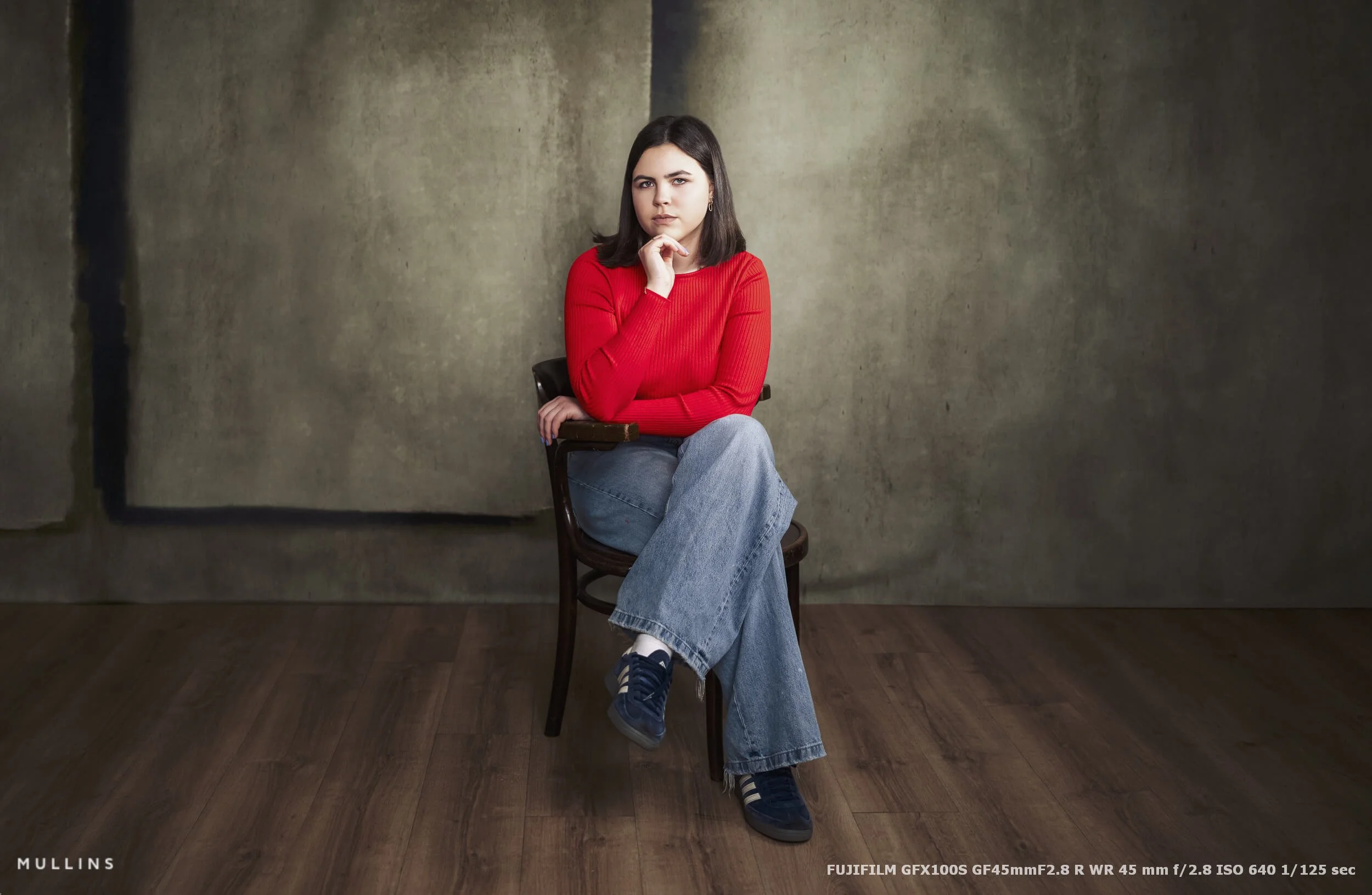
It lets the subject live in the frame. It gives context. It gives posture somewhere to go. Chair, floor, background, negative space - it all becomes part of the photograph rather than something you are trying to crop away. The wider view also creates a slightly more conversational feeling. You’re a bit more present in the image, I think. Not literally, obviously, but the viewer feels the relationship between subject and photographer more.
Several of the seated portraits from this session were made with the 45mm for exactly that reason. I wanted the studio space to breathe a little. I wanted the chair and the shape of the body in frame. I wanted the background to do some work without taking over.
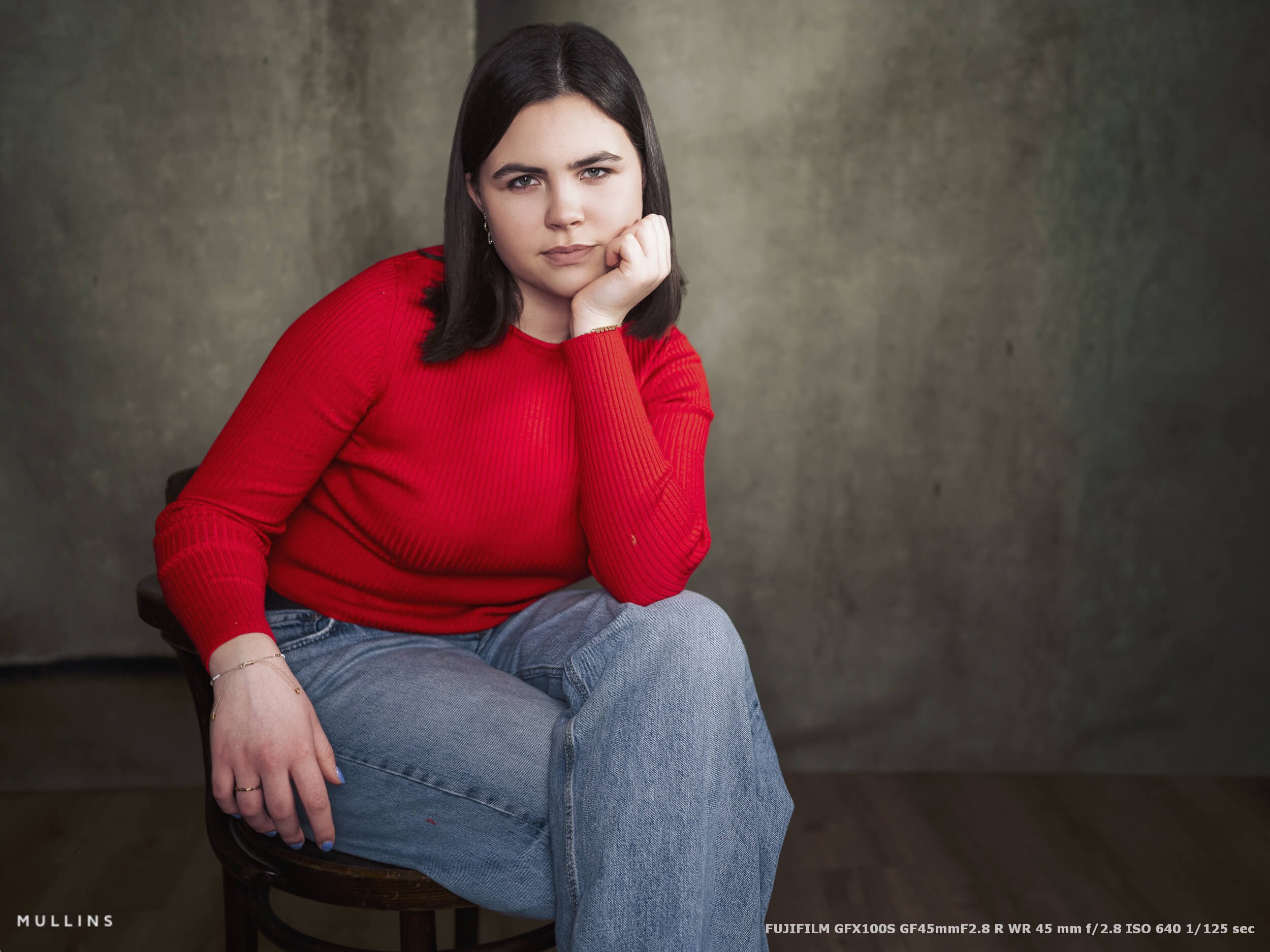
The GF80mm, on the other hand, narrows the conversation a little.
It is more intimate. More selective. It lets expression carry more of the picture because there is less competing for attention. It’s a superb portrait lens, and that slightly shallower rendering gives the subject a lovely separation without things becoming too dreamy or overblown.
In the tighter head-and-shoulders portraits, it gave me exactly what I wanted.
So for me, this wasn’t really about which lens is better.
It was about what each lens says.
The 45mm says more about the person in the space.
The 80mm says more about the person within themselves.
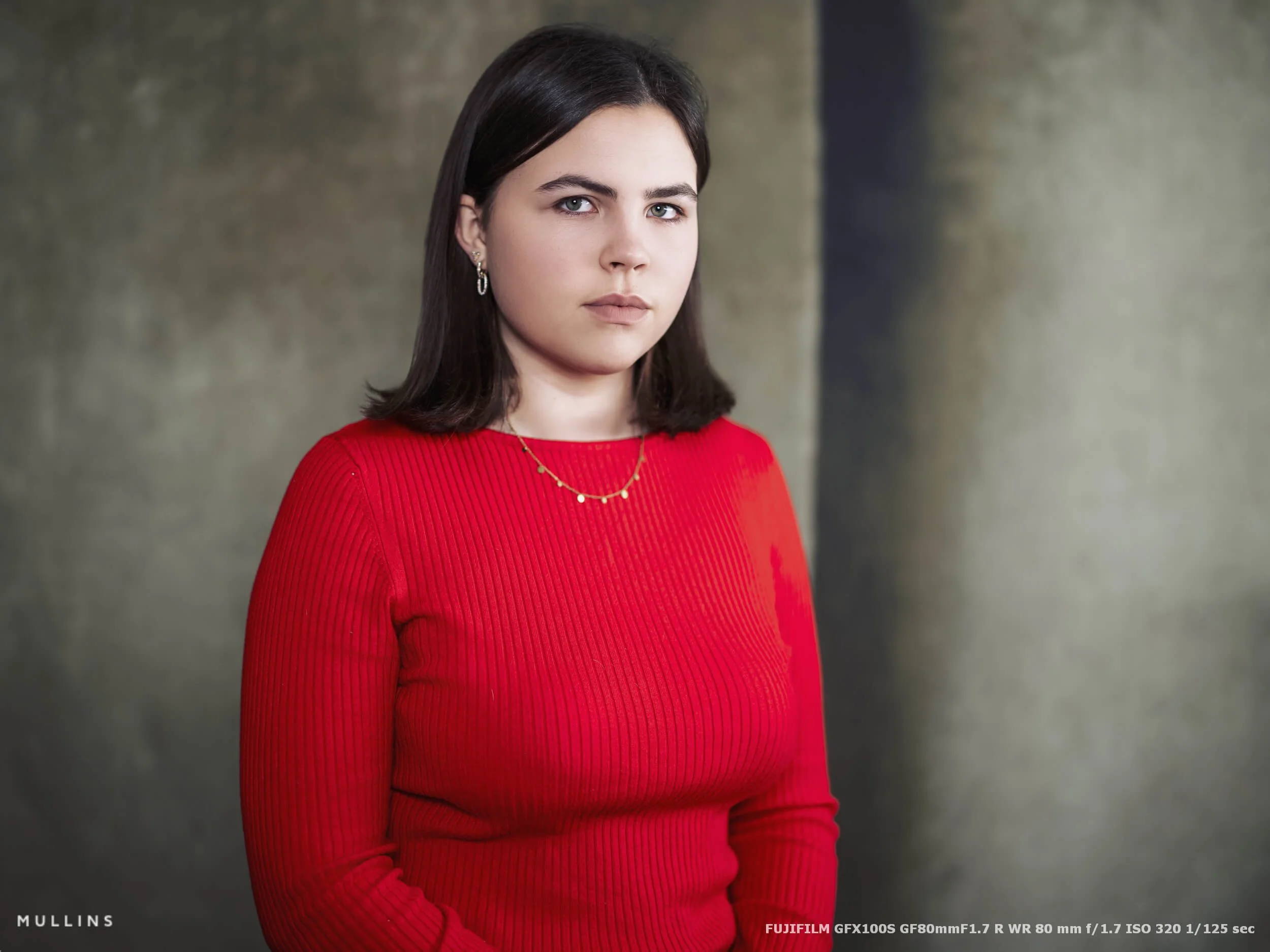
Lens choice changes emotional distance, not just framing
I think this is something photographers sometimes miss. I know its something I’ve had to learn and think more about.
We talk about focal length in practical terms, which is fine and necessary, but not always in emotional ones. We talk about working distance, compression, distortion, subject separation. All useful and true. But the emotional effect of a lens matters just as much.
A wider lens used well can feel open and present. A longer lens can feel quieter, more private, more concentrated. Neither is right or wrong. They simply do different jobs.
During this shoot, the GF45mm helped me make portraits that felt a little more observational, even though they were posed. The GF80mm made it easier to strip things back and let face, expression and gaze do the heavy lifting.
That’s a useful thing to remember when planning a portrait session. Don’t just ask what will flatter the subject. Ask what emotional distance you want the photograph to have.
They are not quite the same question.
Directing someone you know is a different skill
One of the other interesting parts of this shoot was realising that directing someone close to you is not the same as directing a client.
With a client, there’s a sort of rhythm to it. You guide, reassure, adjust, encourage. It’s part technical skill, part social skill. You build momentum as you go.
With someone you know this well, you can often say less. In fact, saying less is sometimes better. Too much direction can make the whole thing feel oddly artificial, especially when the person already knows what you are doing and why.
So this shoot was fairly simple in that respect.
Small adjustments. Turn slightly. Drop the shoulder. Lean back a touch. Chin forward a fraction. Hold that.
Nothing too elaborate. I was mostly responding to what she naturally gave me and tidying the frame around it.
That’s probably worth saying for photographers who think portrait direction has to be complicated, as I used to think. Very often it doesn’t. Particularly when the light is right and the subject has a strong presence anyway, your job is not to invent the portrait from scratch. It’s to recognise it when it appears and not ruin it by over-handling it.
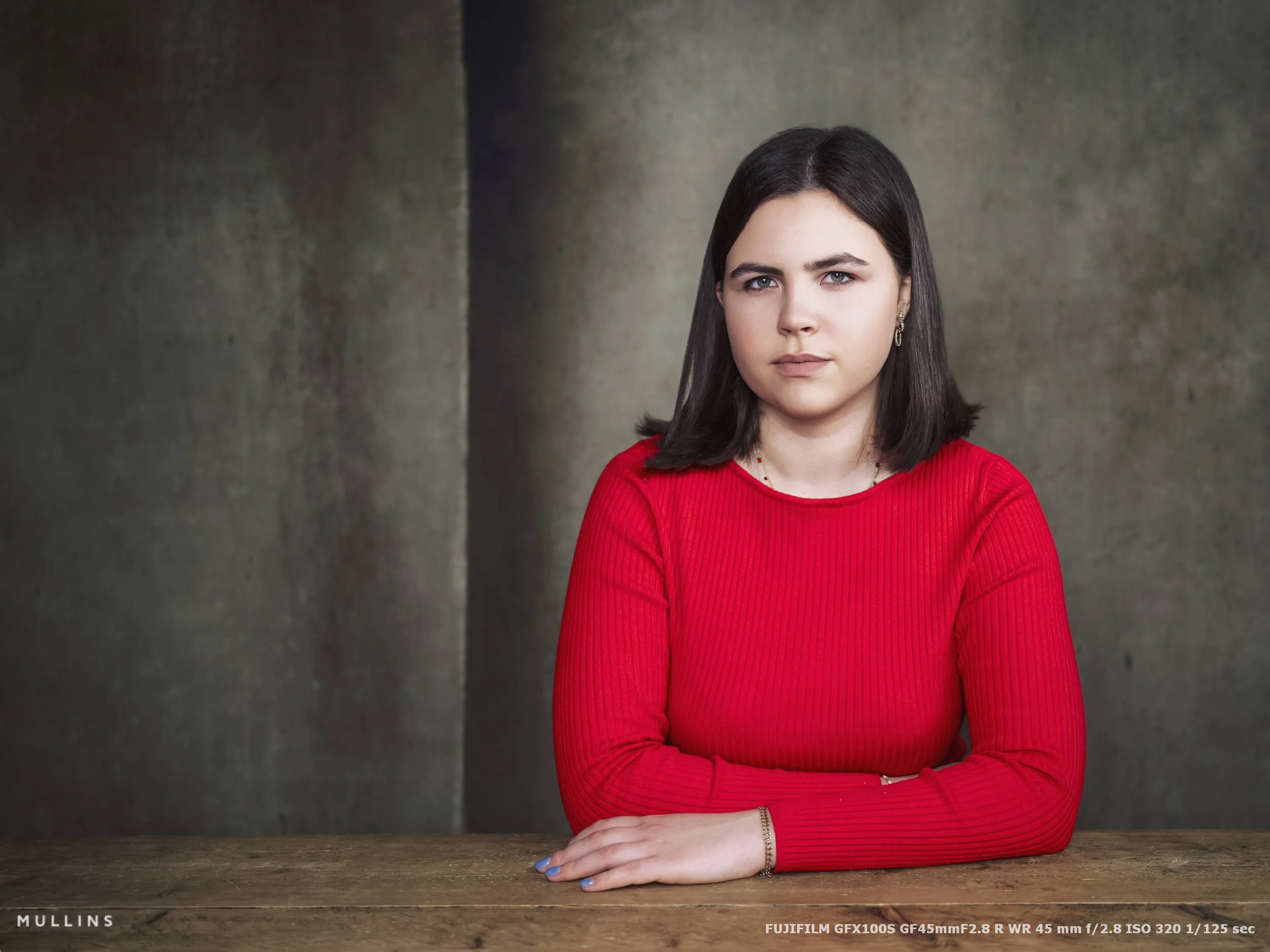
Medium format matters, but not in the way people sometimes think
Yes, the files from the GFX100S are beautiful. The detail is extraordinary. The tonal transitions are lovely. Skin, fabric, subtle changes in light across the face - all of that is rendered with a sort of ease that medium format does very well.
But I don’t think the real value is just sharpness or megapixels. Not for portraits.
In fact, I shared a shoot recently in which I challenged you to identify images taken with a GFX100S and a Fujifilm X-E5.
What I notice more is the sense of depth and tonal subtlety. There’s a gentleness to the way the files hold information. They don’t feel brittle. They don’t fall apart when you start shaping the final image. There’s just a bit more room in there. A bit more grace.
Still, the camera isn’t the story.
The story is always the person. The camera simply lets you do that story justice, or not. On a good day, with the right lens and the right mood in the room, it helps. But it doesn’t replace seeing and observation.
Photograph the person you think you know
I suppose that’s the main takeaway from all this.
If you regularly photograph your children, your partner, your friends, or even repeat clients you’ve worked with for years, there’s a danger in assuming you already know the picture before you lift the camera. That can be a problem. It can make you fall back on old habits and assumptions.
This shoot reminded me to slow down and look again.
Not at the version of Rosa I’ve photographed for years, but at the person sitting in front of me now.
That is probably the real job in portraiture. Not to force a result, and not to rely too heavily on familiarity either, but to stay curious. To keep looking. To let the person surprise you a little.
When that happens, even a simple studio setup, a chair, a plain background, and two lenses can be more than enough.
A note on the editing of these photos
I shot these as full-size RAW files, made my selects in Photo Mechanic, then brought everything into Lightroom for a few minor exposure corrections before finishing the look with my own Lightroom profiles and presets.
I wanted to keep the files clean, natural and consistent, with just enough shaping to give them the final feel I had in mind. If you’d like to see the tools I use for that, you can find my Lightroom Presets here.
Final thoughts
For photographers, I think there are a few useful lessons to be learned from a shoot like this.
First, familiarity with your subject is helpful, but it is not a substitute for observation.
Second, lens choice affects the emotional feel of a portrait just as much as the technical look.
And third, a portrait session does not need to be overcomplicated to be effective. Sometimes it is just about good light, a clear visual idea, and enough patience to wait for the frame to settle.
That was certainly the case here.
These images may be more controlled than the candid photographs of Rosa people will already know, but they still feel connected to the same thread. At least I hope they do. Different method, perhaps, but the same honest pictures of somebody I know and love, while trying not to assume I know everything.
That tension is interesting to me. Perhaps it always will be.
If you’re a portrait photographer, or even just someone who photographs family a lot, it might be worth asking yourself: are you photographing the person in front of you, or the one you remember?
Because those can be very different pictures.